
Here's the next article in our series about starting a cosmetic lab. Here is the basic equipment you'll need.
- Containers
- Weighing equipment
- Mixers
- Heating & Cooling equipment
- Lab supplies
- Testing equipment
In this article we'll talk about an important device in making your prototype formulas, the weighing equipment.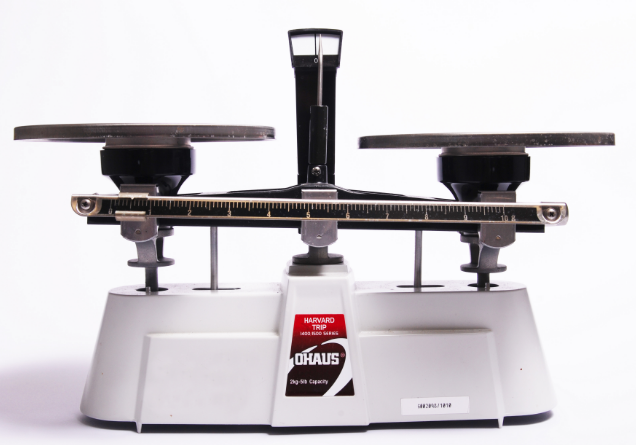
Making formulas
First, a word about making cosmetic formulas. You might find recipes on the Internet for cosmetic products that list ingredients in terms of volume measurements like tablespoons or cups. While this works well enough for cooking food, it does not work for cosmetic formulas. Whenever you are making a formula you need to measure things in terms of mass, not volume! This is because volume measurements are just not accurate enough. To see why, consider the measurement of 1 tablespoon.
If a formula calls for 1 tablespoon of water, that is the equivalent of 14.8 g (see this conversion calculator). If you were making a 100 g batch that would be the equivalent of 14.8%. Now, suppose you didn't get exactly 1 tablespoon but were off by something like 10%. That's equal to 13.3 g or 13.3% in your formula. Your small measuring error has been magnified and you've changed the formula significantly. If you weighed out the 14.8 g on a scale you could get much closer & have a more accurate formula.
Scales
Therefore, when setting up a lab it is crucial that you have a scale to accurately measure your ingredients. There are a wide variety of scales available and the cost can range from rather cheap to obscenely expensive. The exact scales you get will depend mostly on the size of the batches you'll be most often making. The ideal cosmetic lab will have three types of scales.
Small measurements - This is a scale that can measure things in quantities of 100 g down to 0.001 g. When you are making smaller sized batches you'll need to have accuracy on the lower end. Ingredients like dyes can have a huge impact on the resulting batch so if color is going to be part of your formulating get a good, small sized scale. For this scale having it enclosed is helpful to prevent any air currents from impacting the measurement. This makes it less convenient to use by improves accuracy. A scale like this balance from US Solid is a reasonable choice. Mid-range measurements - This is the scale which you are going to use most often and it is the most important one to get. This scale can measure ingredients from 2000 g down to 0.01 g accuracy. For most anything you make you could probably use this scale. Especially if your batches are less than 1000 g. When getting a scale for this purpose you'll want to make sure it is accurate enough but is also durable enough to maintain its accuracy while being used repeatedly. You also don't need to worry about air currents so no enclosure is required. In fact, it's better not to have one because it makes taking measurements easier. A scale like this Ohaus scale is a typical choice.
Large measurements - If you are going to make larger scale batches (>2000 g) then you'll want to have a scale which can make larger measurements than 2K. To make these batches you should have a scale that will measure up to 10Kg. Although, if you are making really large batches, for example production sized batches, you'll want to have an even larger scale. The larger you get however, the less accurate the measurement. However, accuracy is not as important as your batch gets larger. If you are off by 2 g on a 10,000 g batch, it is much less impactful than if you are off by 2 g on a 100 g batch. For a large measurement scale something like this scale would be reasonable.
is the most important one to get. This scale can measure ingredients from 2000 g down to 0.01 g accuracy. For most anything you make you could probably use this scale. Especially if your batches are less than 1000 g. When getting a scale for this purpose you'll want to make sure it is accurate enough but is also durable enough to maintain its accuracy while being used repeatedly. You also don't need to worry about air currents so no enclosure is required. In fact, it's better not to have one because it makes taking measurements easier. A scale like this Ohaus scale is a typical choice.
Large measurements - If you are going to make larger scale batches (>2000 g) then you'll want to have a scale which can make larger measurements than 2K. To make these batches you should have a scale that will measure up to 10Kg. Although, if you are making really large batches, for example production sized batches, you'll want to have an even larger scale. The larger you get however, the less accurate the measurement. However, accuracy is not as important as your batch gets larger. If you are off by 2 g on a 10,000 g batch, it is much less impactful than if you are off by 2 g on a 100 g batch. For a large measurement scale something like this scale would be reasonable.
If you can only afford one scale for a cosmetic lab I would suggest getting the mid-range measurement scale. This will be accurate enough for most purposes.
Key attributes of a scale
Just to summarize some of the key qualities you want to look for in a scale
- Measurement range - you need something that has a wide enough range that will work for most of the batch sizes you'll have to make.
- Accuracy - you need something that will be accurate enough to measure the smallest ingredient amounts you might measure. The measurements should also be repeatable so when you measure the same thing multiple times, you get the same result.
- Durability - Get something from a brand proven to be useful under laboratory conditions. The scales that people use in home kitchens are not typically durable enough.
- Calibration - you should be able to calibrate the scale to ensure that it remains accurate over the life of its use.
Other supplies
In addition to the scale there are other useful supplies that you should get for your cosmetic lab. These include weigh boats, pipets, and spatulas.
Plastic, disposable pipets are useful for measuring liquid ingredients.
And stainless steel spatulas are helpful for scraping out containers to ensure you get as much of the measured ingredient into the batch as you can.
As you can see, there is a wide range of choices and prices when it comes to getting a lab scale. If you are trying to keep your costs low, you can try one of the inexpensive kitchen scales, but if you are serious about being a cosmetic chemist you'll need the accuracy of a more expensive lab scale. But above all else, always measure your ingredients in terms of mass, not volume!
Learn more: This topic is covered in depth in our The Complete Guide to Cosmetic Formulation.
Related Reading
Comments are read-only. Join the discussion on the Chemists Corner Forum.